
Written by David Braden and published in Mother Earth News

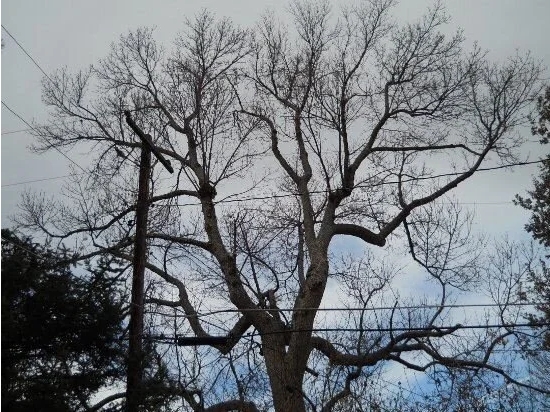
Often the design feature of a suburban yard is a big shade tree. What do you do when that big tree in your yard begins to die? For a suburban lot there can perhaps be no greater change. All of a sudden that deep shade becomes full sun and it may take 30 years to grow another tree to replace the one you just lost. But, when you finish grieving, the loss of that tree is a great opportunity to increase the diversity of your habitat.
There are two permaculture principles that apply. The first is to creatively use and respond to change. The second is to produce no waste. Consider having the tree processed in place and using the logs and wood chips to build a hügel mulch. You will save the expense of having those materials hauled away and the expense of establishing a lawn in the old area of shade. The hügel mulch can then be planted to a guild of plants that will support each other using the materials from the old tree as nutrients for up to 30 years. That saves the expense of mowing, fertilizing, and watering the lawn. Instead of spending time and money maintaining a lawn that is seldom used, you will have created a habitat for beneficial insects, including the pollinators, and an annual supply of food for people and other visitors to your garden.
In the Denver area we have this opportunity coming from two different directions. First, as Denver was developed, a popular landscape tree was the silver maple. Many of those trees are coming to the end of their lives and becoming a hazard. They are at risk of blowing over or losing large branches during high winds. The other potential for tree loss is the emerald ash borer. It has recently been found in the Denver area and if it spreads about 20 percent of the urban canopy is at risk. All those trees being lost could mean a great deal of expense for landowners who remove the trees and landfill the wood. There is even more expense to amend the soil and lay sod to put in a lawn the old fashioned way. An alternative is to creatively respond to the change and not waste any of the material.
Seen at a larger scale, this kind of response changes how neighborhoods evolve over time. Instead of a cycle of removal, disposal, and replacement with more resource-intensive landscapes, each loss becomes a point of regeneration. The soil is enriched rather than stripped, water retention improves rather than declines, and each site begins to function more like a living system than a managed surface. Over years, these small redesign moments accumulate into a more resilient urban canopy mosaic that is diverse in age, species, and function rather than dependent on a narrow palette of aging ornamentals.
This shift also changes the role of the land steward. The task is no longer simply to maintain appearances, but to participate in ongoing transformation, interpreting change as information rather than disruption. In that sense, a dying tree is not an ending to be managed away, but a transition point where stored energy, structure, and biology are handed back into the system in a more useful form.