
Written by David Braden This links to his blogspot!
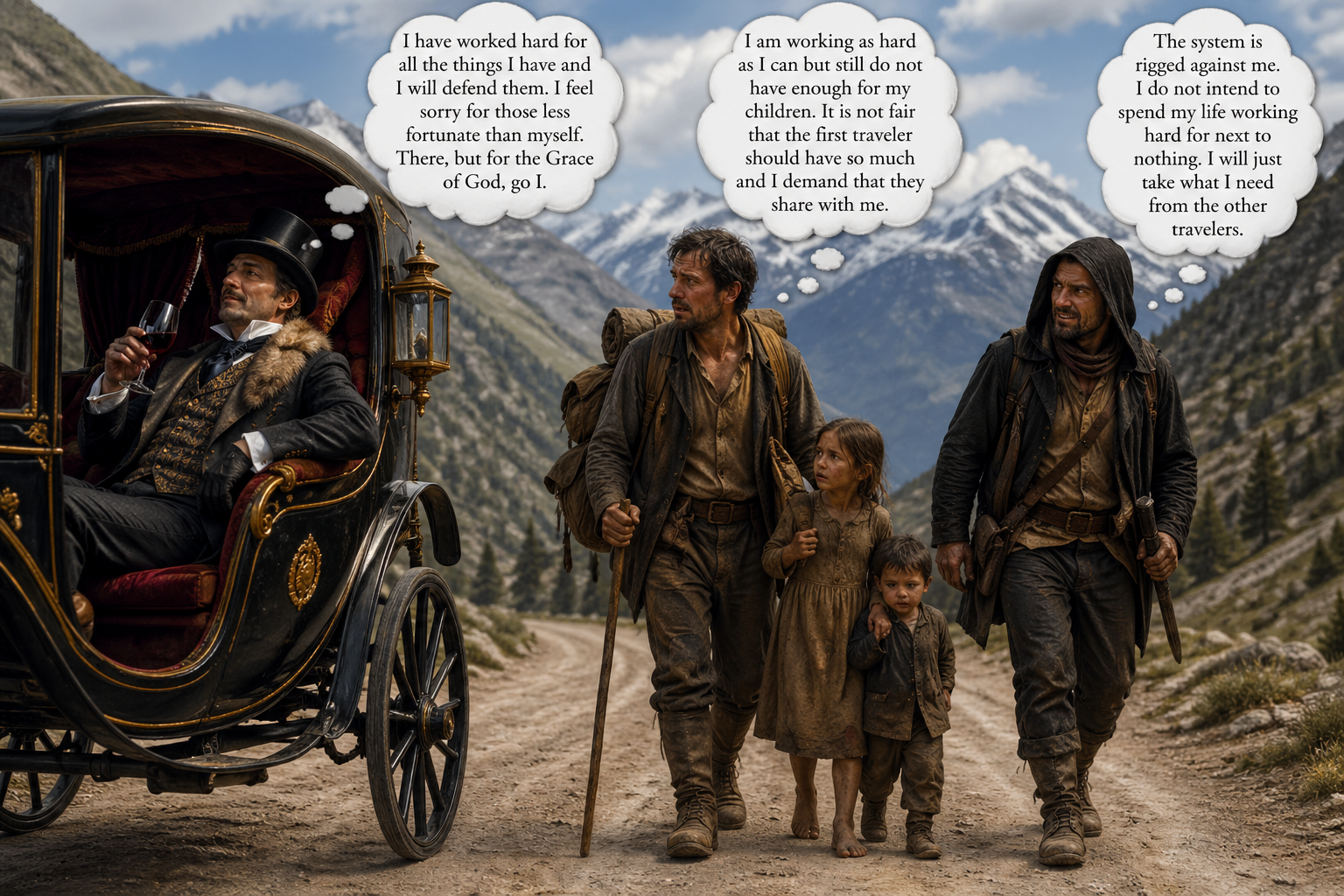
There are three travelers on a great journey across an endless prairie. In one direction lies a barren and impoverished place. In another direction lies a place of abundance.
The first traveler is traveling in great luxury. This traveler is thinking, “I have worked hard for all the things I have and I will defend them. I feel sorry for those less fortunate than myself. There, but for the Grace of God, go I.”
The second traveler is struggling to get by with next to nothing. This traveler is thinking, “I am working as hard as I can but still do not have enough for my children. It is not fair that the first traveler should have so much and I demand that they share with me.”
The third traveler agrees that things are not fair. This traveler is thinking, “The system is rigged against me. I do not intend to spend my life working hard for next to nothing. I will just take what I need from the other travelers.”

The conflict among these travelers takes place within the vessel that transports them across the prairie. This vessel and its journey began as a single cell first dividing 3.5 billion years ago.
About a million years ago the vessel began to produce organisms resembling our travelers. None of them is fully responsible for the circumstances in which they find themselves yet, in the conflict among them, each believes they own the truth.
The conflict among these travelers is wearing on the vessel that carries them across the prairie. The travelers cannot see that repairing the vessel would resolve the conflict.
The vessel fuels itself through a single operation. It uses sunlight to create the molecules that form its organisms. When these molecules are cycling through plant, animal, fungal and bacterial processes they build up in the vessel. When the cycling is broken the molecules are lost and the vessel loses capability.
Repair of the vessel requires the contribution of all its passengers. Only we humans are capable of seeing past our individual needs and tending to the needs of the vessel. In that step we begin to chart a course to an abundant future.
This is the First of a Four Parts.
Human beings normally go through a transition fairly early in life. It is the point where we leave behind the care givers who saw us through our childhood. It is the point where we face a future that will unfold based on our own choices.
Perhaps you remember the uncertainty that you had at that time. Imagine now how that moment might be different if your care giver was different. Imagine how that moment was for each of our three travelers.
The first traveler understands life to be a competition. In a competition we expect that there will be winners and losers.
If you are one of the lucky ones, your care givers taught you the rules of the game and the skills it takes to play it. How would things be different if your care giver told you that you would never amount to anything? How would things be different if you were in foster care because your parents where in jail? Imagine trying to play the game when you don’t know the rules and don’t have the skills.
When we turn our backs on the losers in the economic competition we create the second and third travelers.
I can remember that time when I transitioned out of the care of my parents. I had no confidence in my ability to “make it” in the world. What if I did not have a college education and a law degree? What if no one was willing to hire me or I failed at building a law practice?
In fact the market only has a limited number of jobs. Only some of those jobs pay a living wage. What do we expect of people who work as hard as they can and still cannot give their children what they need to thrive? How would you feel if there was no prospect that you would ever get ahead in life? Perhaps you would believe that life is controlled by a powerful elite intent on holding you down.
In a different life I am afraid I might have taken on the views of the third traveler. What if the best job you could find came with a supervisor who used that position to take advantage of you? Is the money worth the humiliation? I might have begun to believe that life is a war in which the victors take what they need.
It is interesting that these three different views of life do not correspond in any way with a person’s socio-economic status. There are corporate CEOs and janitors cleaning toilets who agree that life is a competition. I know some very comfortable people who see themselves in a struggle with a powerful elite. Both the liquor store robber and the hedge fund manager running a ponzi scheme plan to take what they need.
These three views of life have one thing in common. They all assume that there is not enough to go around. What if we could heal the vessel and in that process produce enough food, shelter, learning, health, belonging and purpose for every human to thrive?
That is what we explore at the Living Systems Institute and our story, “How the Cook and the Gardener Saved the World” describes the process that can accomplish that. Perhaps you will join me in understanding that life is a vessel that needs our attention to carry us where we want to go.
Sometimes I just want to take someone by the shoulders and shake them.
“Why can’t you see?”
But, if you can’t see you can’t see . . . the shaking won’t help.
The vessel that carries life through time is the living system on this planet. The vessel is running down because of the way we humans produce the things we need.
The vessel is a complex pattern of interactions. For reasons of expediency we want to simplify things. And as we simplify things the life drains from the vessel. It is sad to see something that could be so robust wasting away for lack of vision. Its like watching a parent lose their vitality except that the wasting of the vessel is not inevitable. The vessel begins to heal as individuals find new ways to interact. New interactions increase complexity.
Why is it so hard to see that the vessel requires complexity to maintain vitality?
I have said this many times in many different ways to many different audiences. The living system on this planet has a single operations and from the perspective of that operation all the wicked problems make sense. Understanding how the living system works shows the way to healing nature and producing abundance. Why is that so hard to see?
The single operation of the living system is to use solar energy to create organic molecules and cycle them through itself. Simple right? But it requires complexity to be vital.
The three travelers are fighting amongst themselves over the things they need from a living system that is severely weakened by the fighting. It is a self reinforcing feed back loop. The more we fight the less there is to go around. The more we fight.
We humans simplified the way we produce things, weakening the living system on this planet, and now there is not enough to go around, and that causes the fighting. A field of corn is an ecosystem simplified to a single species. A concentrated animal feeding operation is an ecosystem simplified to a single species. Resources are imported every year and used up generating waste streams.
Waste is a sign of inadequate complexity.
The living system on this planet is every organism alive right now. That includes every living human. When the living system is able to cycle organic molecules through plant, animal, fungal, and bacterial processes those molecules, those things humans need to thrive, build up. When we break that cycle those molecules dissipate and the things humans need to thrive become scarce.
It is not difficult to assist the living system in becoming more complex. Every living thing has an unlimited capacity to reproduce. Nature wants to be abundant. If you could only see how productive a complex pattern of interactions could be, you would join me in urging your community to come together to find a place for all its residents.
When we begin to open our eyes to this simple lesson about complexity we will be the Living System on this Planet becoming aware of itself.
We humans have a great deal more potential than we use.
We are clever creatures able to adapt to the circumstances in which we find ourselves. Those circumstances, the pattern of interactions among the living things that share our place in the world, only requires a small part of our potential. Perhaps each of us has a fantasy of a different pattern that allows us to flourish.
The way we have structured the world is that each human needs a job that pays money. Each job requires a different set of skills but none requires all that we can be as human beings. The most challenging jobs that pay the most are specialties. They require the specialist to learn in great depth a narrow band of the spectrum of human knowledge. Most jobs pay less and require less.
When our job is to know this special thing, we do not have time to experience for ourselves all the rest of the spectrum of human knowledge. We accept as truth the ideas we receive about the rest of the spectrum. We receive those truths from the groups we trust. We can learn a lot about a person when we know from where they receive their truth. Perhaps it is the National Rifle Association truth, or the Green Peace truth.
When the available jobs do not pay enough to get by, or there are no jobs available for many, we begin to create the second and third travelers. And then those of us who have jobs see that they have to defend what they have and the cycle goes on and on.
At the Living Systems Institute we study how all the living things interacting within a place can obtain what they need to thrive. That requires that we step out of our specialty and see how what we think we know fits within the pattern of everything. The hardest part is the the ‘conventional wisdom.’ The things we all know to be true. If we are not out testing our assumption we will never discover our conceptual errors.
If we are not out testing our assumption we will never discover our conceptual errors.
If we are not testing our assumptions how will we know if there is a better way to organize things?
The opening proposition on the web site for the Living Systems Institute is, ‘Imagine the kind of world you would like to live in. Let’s build that one.‘ What I imagine is a world where every human being is given the safety and challenge to develop their full potential. To move the world in that direction requires that our communities learn to heal nature and produce abundance.
If we truly care about the natural world and our fellow humans it is time to learn to heal nature and produce abundance. We envision The Cook and the Gardener as an organization that will teach our community how to do that. A successful organization will challenge us to adapt what we know about organizing. We will be creating a new pattern to which we must adapt as we go.
When we are successful the organization will accomplish these tasks:
- We will become a keystone species supporting the processes of the many species participating in our community.
- We will become a place for individuals to test their assumptions and learn new skills as they adapt to the changes we are creating in our community.
- We will become skilled as an organization in producing an abundance of food, shelter, learning, health, belonging and purpose for our partners.
- We will become skilled as an organization in delivering the benefits of healthy habitat and healthy food to our community.
This idea of an organization designed to develop the potential of its participants is not unique to the Living Systems Institute. For authority on this approach I recommend the work of Robert Kegan and Lisa Lahey and in particular their 2016 publication, “An Everyone Culture“.
What may be unique to the Living Systems Institute is the idea that the market is not the only way to produce the things our community needs to thrive. There is a better way to produce what we want to be abundant. We don’t want to change the market or replace the market. We want to add complexity. We want to add an additional pattern of interactions that heals nature and produces abundance of the things we need to thrive.
The idea is to come together as a community to heal nature and produce abundance. The idea is that we can do that by investing in the potential of the people participating. The idea is that the participants can be challenged to create a healing and productive pattern of interactions and adapt to that new pattern as they go.
One of the truths that you will hear about solving the difficult problems we face is that solution ‘must be able to scale’. The solution proposed here is not something that can be imposed at a planetary scale. Rather, we think in terms of one community learning to heal nature and produce abundance for itself and then every other community in the world can learn to do the same . . . realizing the potential of their members . . . healing the vessel . . . and coming of age as a species.