
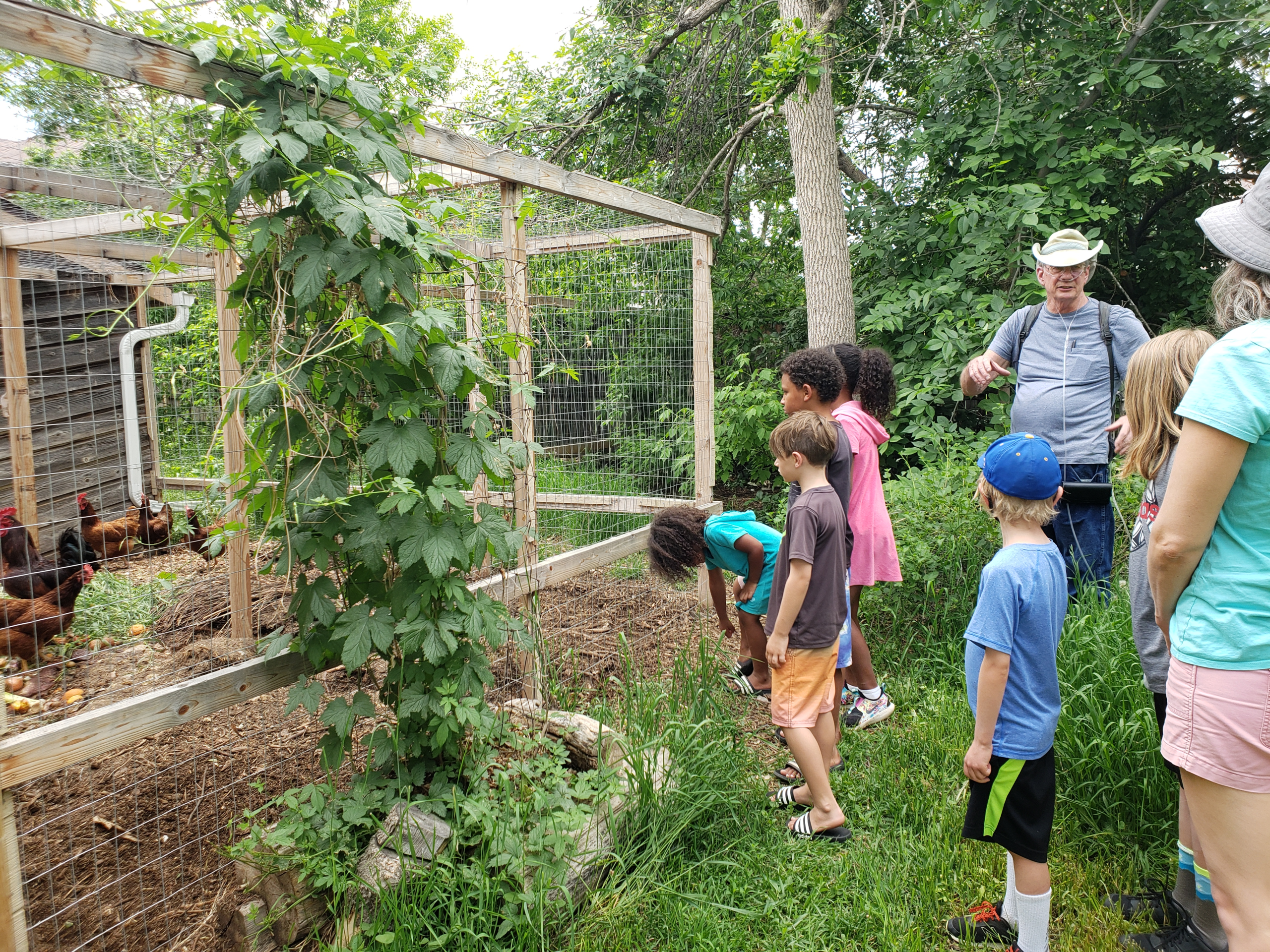
Written by Living Systems Institutes founder, David Braden, this series of lessons describes how we can take action to move a place toward greater health, abundance, and beauty.
Welcome to The Agent of Habitat curriculum!
We participate in an eco-economic-social system. That system expresses itself in different places on a continuum. At one end of the continuum there are few humans or other species participating. We think of these places as barren and sterile. At the other end of the continuum there are many humans and other species participating. We think of these places as beautiful and healthy.
Ask yourself the question, “What new interactions within my power would move my place in the direction of health and beauty?” As you begin to find answers to that question you become an Agent of Habitat.

Our task is to create the world we want for our great grandchildren . . . the seventh generation.
Our great grandparents are the first generation.
We are the fourth.
The seventh generation is our great grandchildren.
It will take 21st century wizards to create this world.
20th century wizards created wonders by taking things apart and understanding the parts. 21st century wizards will create wonders by putting things together and understanding the function of wholes. These wizards we need will be agents for building up the habitat. I call them Agents of Habitat.
An Agent of Habitat realizes that it is up to them. No one else is going to create the world we want for our grandchildren. Unless they do it our grandchildren cannot have that world.
It does not take money. The world we want is a pattern of activity that includes everyone and all the many species. The world we want has a place for everyone. It is a world where everyone can get what they need to thrive. The resources we need are all the people and all the species without a place in the pattern we have now.
The people and the species without a place in our world are resources.
They represent potential. They represent the potential to create a pattern of activity that includes everyone. They are unrealized potential because the market has no use for them. But the market is not the only way to produce things. We can also engage the unrealized human and biological potential where we live in new patterns of activity that produce what people need to thrive.
When we pave a piece of ground we reduce the biological potential of that space to zero. But, if you stop sweeping it, nature will begin to reclaim that potential. The difference between what could be living in a space and what is living in a space is unrealized biological potential.
Now think of all the contributions that could be made by people who are unemployed, or all the people in prisons, or the 4.3 billion people living on less than $5 a day, or even the student or home maker who is not producing anything in their spare time. That which people could produce but do not, because no one will pay them, is unrealized human potential.
You may be grateful that you have found a place in the market.
You may have a niche that allows you to provide for your needs. You may feel sorry for those who cannot compete in the market. You may give what you can to charity because you are concerned about social justice and the environment. There is still a need for Agents of Habitat. Even if you have your niche in the market it would be better for you if we had a complimentary system of production where anyone could participate . . . a place where you could go if you got laid off . . . a place to go if you wanted to develop a new marketable skill . . .
As good as your life is because you have a place in the market, our world suffers from the waste of human and biological potential . . . and because your habitat suffers so do you . . . our individual well being is inseparable from the well being of the pattern of activity in which we find ourselves. We owe it to our great grandchildren to be the wizards that learn to tap into that potential and create a pattern that includes us all.
It will take Agents of Habitat to build the world we want . . .
it all depends on individuals making that choice . . . why not you?

To be an effective agent for your habitat you need to know your place within the flows.
You are a vortex in the flow of air around the planet.
You are a whirlpool in the flow of water from the mountain to the sea.
You are a temporary pattern of organic molecules within the flow of nutrients through the ecosystem and each of those molecules is built with photons of the sunlight flowing through the solar system.
Like every other living thing, it is the cycling of these flows within your skin that gives you life. Unlike other species we humans can consider how we will place ourselves in the flows.
Your gathering of possessions is a way station for goods as they flow through the economy and if you pay for services you help to create other way stations of possessions.
Your mind is a processor within the flow of information through our culture. It gives you the power to influence all of these flows. Becoming an agent of habitat is to learn to use your influence effectively . . . to learn to adjust the flows to benefit you, your groups and the living things around you.
See your self in the pattern of flows.
Observe where you are in the flow of air, water, nutrients, material things . . .
Now pull back and observe the whole pattern . . . observe where each flow comes from
. . . where each flow is going . . .
Pick one thing. Observe how that thing flows to you . . . you take it in . . . you send it out . . .
Choose to change one thing in the flows . . . see how that changes the pattern.
Choose another thing to change . . .
That is how we change the world to be the one we want.
Start with small steps when you are ready:
Get a house plant to clean the air in your room. Plant a rain garden at the downspouts on your home. Find a bucket for worms to eat the scraps off your plate. Be conscious of the goods and services that you need to thrive. And learn more every day until you find your voice . . .
The more you observe the pattern of flows in which you find yourself the more opportunities you will see to use your influence. The more you practice using your influence the more effective you will become. The greatest influence you can have is to empower others to do the same.

Visualize yourself as a pattern in the flow of organic molecules moving through your ecosystem.
You can begin to observe the characteristics of the pattern as it changes when you move. The flows in the city are different from the flows in the suburbs are different from the flows in the countryside. Each space has a mix of species and a mix of humans participating. Observe how you feel in one place compared to another place. What makes one place comfortable to you and another uncomfortable?
Think of it as a continuum of welcoming.
At one end of the continuum there are few species and few humans welcome. We think of this kind of place as sterile and barren. At the other end of the continuum there are many species and humans participating. The most beautiful places on earth have the greatest variety of participation. We think of this kind of place as healthy. Think of your task as an agent of habitat as moving those places where you have influence in the direction of health. Make your place more welcoming . . . one new relationship at a time.
Carbon Cycling is the Key to a Welcoming Place.
There is an exercise you can use to help visualize the flow of nutrients through a habitat. It is a story about carbon adventures. Hold up your hand in the shape of a “C”. Imagine it with googly eyes and floating eye brows. (This should be an animated short :-). If you have the talent to produce this kind of short video and want to contribute please contact us.)

“Hi, I’m C, and I want to tell you about my latest adventure.”
“I was just floating around with a couple of oxygen buddies when we got sucked into the stoma of a leaf. I spent a whole summer doing support work for the sugar factory in that leaf. It could have been worse. I know Cs that become part of tree trunks for 100 years or more.”
“When fall came the leaf fell to the ground and a bacteria took me in as it absorbed the leaf. One thing led to another as I was pooped out of one thing, taken up by another, that was eaten by another and then pooped out again, taken up again . . . . I was nematode, grass, rabbit, mushroom, beetle, . . . “
( . . . this part can be extended as long as you can hold the attention of your audience . . . we are also looking for good story tellers. Write up your version of Carbon Adventures and we will share it with the animators.)
“Some time later I was part of a worm crawling through leaf litter and this chicken eats me. I came out of the chicken as part of an egg and the egg was eaten by a human. Then I was cruising through the blood stream of the human until I was absorbed by a muscle cell . . . the cell contracted . . . there in the muscle cell were two oxygen buddies . . . we grabbed a hold of each other flowed out through the lungs . . . and here I am ready for another adventure . . . “
The more participants in the pattern of flows of a place
the more carbon is tied up in organic molecules that make up the participants. The greater the variety of species the more ways the carbon can be retained in the system before it is returned to the atmosphere. The more there is flowing through the system the easier it is for individuals to find what they need to thrive . . . In other words, the more carbon cycling the more welcoming the place . . .

This is how we will heal nature, produce abundance and begin to pull carbon from the atmosphere.
Cycling carbon locally by welcoming all species to participate is by its very process healing nature. If we employ all the unrealized human potential on this planet in the process of cycling carbon we will provide what every one of those individuals need to thrive.
The living system on this planet has proven that it has the capacity to remove as much carbon as we want from the atmosphere. You will hear things about the ability of soils to capture carbon, for example, and that is true as far as it goes. You now know that carbon is captured in the living things participating in the flows of nutrients within a place . . . and you know that you can influence an increase in the number of living things participating in your place . . .
and it is really as simple as that . . .
we heal nature, produce abundance and pull carbon from the atmosphere as individuals work to create a welcoming space where they live.

The new interactions we need to heal nature, produce abundance and pull carbon from the atmosphere will not involve the exchange of money. Money fueled interactions are not bad. We have neither the influence nor the desire to change the way money works. Money transactions are just not suited to tap into the unrealized human and biological potential resident in our neighborhood.
Money fueled interactions are market based. Markets are limited, by the law of supply and demand, to those things that are relatively scarce to people with the money to pay for them. The unrealized human and biological potential of a place is everything else. The resources available to us are those things that have no niche in the market.
This is not communism . . .
The alternative is for groups of people to cooperate in developing the capacity to produce things for themselves. No, this is not communism. Every business corporation is a group of stakeholders who cooperate to develop the capacity to produce something. The difference is producing for ourselves or producing for the market. Producing for ourselves we can use the resources that have no place in the market. All production for the market is limited by the law of supply and demand.
This is not barter . . .
Say that I have a pickup truck and you have automotive mechanical skills. If you fix my truck and then I let you use it to do something . . . that is barter. Barter is a market based system. My ability to barter for truck repairs is limited to the mechanics who have the need to use a truck.
In a different scenario, you and I use the truck to salvage some building materials and build a chicken coop. We co-own the coop, the chickens we raise in the coop, and all the eggs produced. We allocate the cost, work and produce between us. Our investment in the truck is not an exchange between us. It is an investment in the capacity to produce chickens and eggs for ourselves.
Not everyone wants to grow food . . .
True. But every human wants to have food, among other things, and every human has something to invest in producing those things.
Every human being has discretion as to how to use their time. With a job or investments we may have discretionary money as well. Food is just the example. We all need food, shelter, learning, health, belonging and purpose to thrive. If we pool our discretionary time and money to produce those things for ourselves, there is less we need to purchase in the market . . . we need less money. And not everyone has to grow food.
As an agent of habitat you know that it is your responsibility to create the world we want for our great grandchildren, that we all participate in a pattern of interactions within which we have influence, and that we can use that influence to make our part of the pattern more welcoming.
We can obtain a return on our efforts by investing in the production of food, shelter, learning, health, belonging and purpose. There are four levels as this idea scales:
1 – invest in the capacity to produce things for your family by your family.
This is known as self sufficiency. It may not seem significant. None of us wants to spend all
our time that way . . . Still, each of us can convert our landscape into a deep mulch system
(and spend less time and money than maintaining a lawn) . . . grow a few of our own vegetables
. . . maybe even have an aquaponics system in a greenhouse that provides salads all winter . . .
and still engage in all the diversions that please you.
2 – We call the capacity of our neighborhood to provide for itself community
sufficiency technologies . . .
Imagine the discretionary time and money available in your neigborhood. There is someone
in your neighborhood who would think of raising chickens as a pleasant diversion. There is
someone there who would think of raising fish as a pleasant diversion. For every task we can
imagine to improve the cycling of carbon in our neighborhood, there is a neighbor of yours
who would enjoy doing that . . .
Think of all the facilities you could build if all your neighbors kicked in a little of their
discretionary time and money . . . and all of you can still engage in all the diversions that please you.
3 – We call the capacity of our town to provide for itself a community
investment enterprise . . .
Imagine all the people in your town or city that do not have the discretionary
money it takes to invest in producing for themselves. When you do not have enough money
all of your time is consumed with just getting by . . . what if our community invested
in the capacity to employ that latent human potential to produce food, shelter, learning,
health, belonging and purpose for the whole town . . . ?
4 – We call a group of people that begin pooling their resources to acquire
the capacity to provide for themselves a self help corporation . . .
We do not have to imagine all the different ways that people could organize
themselves to provide for themselves while healing nature, producing abundance and
pulling carbon from the atmosphere. We just need to get the ball rolling
and people will figure things out as they go.
Some have more discretion than others.
Our discretionary resources are a consequence of the fortunes of our ancestors and
the results of our own choices. Those of us lucky enough to have both discretionary
time and discretionary money have the greatest responsibility to the future . . .
because we are the ones capable of investing in the future. The main thing holding
us back is the belief that solutions have to be market solutions or government solutions . . .
There is a third choice . . . as agents of habitat we can take matters into our own hands.

Let’s revisit this idea of flows from lesson 2
Each of us, every living thing, is a temporary pattern of organic molecules in the flow of nutrients through the ecosystem. We depend on that flow and the other flows for our existence. The pattern of flows that allows us to thrive is our habitat. Within that pattern we have a range of influence . . . our locality. Together these two ideas define our place in the world.
We become agents of habitat to make a contribution to the well being of our place. This is not instead of our personal success. This is not instead of the success of our group. This is an ongoing effort that we make because we understand that our individual well being depends on the well being of our habitat. The well being of our habitat depends on the interactions among the living things participating.
The story of carbon adventures tells us that, as we increase the number and diversity of the individuals participating, we also increase the volume and variety of nutrients cycling. The more nutrients being produced the easier it is for individuals to find what they need to thrive. That makes our place more welcoming.
How we use our discretionary time and money affects the flow of goods and services through our place. More individuals participating means more goods and services cycling through our place. That makes it easier for individuals to obtain what they need to thrive. That makes our place more welcoming.
How we communicate with the people around us affects the flow of information cycling within our place. When we increase the number and diversity of view points considered we increase our access to the information we use to obtain what we need. Openness to communication makes our place more welcoming.
Observe the individuals participating in the pattern of flows in your locality.
Compare that with the individuals who could be participating but are not.

You know some of the examples:
- We cannot have lady bugs unless we grow aphids.
- We cannot have monarch butterflies unless we have milkweed.
- We cannot participate in the money economy unless we have a job.
- We cannot have a job unless we have marketable skills.
For each individual of the many species that is not contributing to the flows in our place there is a limiting factor. When we are able to use our influence to change these limits, and allow more participation, the flows through our habitat increase.
This is the opportunity we seek
We seek to tap into the unrealized potential in our place . . . increasing the nutrients flowing through our place . . . increasing the goods and services flowing through our place . . . increasing the information flowing through our place . . .
When we assign responsibility for the condition of the world to someone else we give them our power to create it. Think of it this way:
- We will not change the way that government works,
- We will not change the way business works,
- We will not change the way ecosystems work,

We can only change what we control. We can change the way we interact with the individuals of the many species resident within our locality. If we make these interactions productive, so as to sustain them, the ecosystem will change, business will change and government will change in response.
I recently had a discussion with a fellow interested in land reform. The idea is, “If I only had my own land that would solve my problems.” My question is, “What will you do with this land? How will the land produce what you need to thrive?”
I know a number of people interested in alternative currencies. The idea is, “If only we had our own currency that would solve the problems.” My question is, “How will this new currency produce what you need to thrive? What will give value to your currency?”
It is not one thing that we want. It is the capacity to produce what we need to thrive that we seek. It is not the place that is important. It is the nutrients, goods and services, and information cycling in a place that provides the opportunity and limitations. Increasing the required flows, making our place more welcoming, means increasing the quantity and diversity of individuals of the many species participating in our habitat.
A complex adaptive system, like the one we experience, emerges from individual participants following relatively simple rules.
– In a flock of birds each individual bird is trying to stay a certain distance from neighboring birds . . .
– Our global economic system operates by each individual participant following the law of supply and demand . . .
– We will create the world that we want . . . the one where we have healed nature and produce abundance
. . . when we develop the rules for neighbors to work together to improve their habitat.
Imagine a world where the rule was that every individual is welcome.

Let us revisit this idea of flows once again.
The reality of our existence is that we are each a temporary pattern of organic molecules within the flow of nutrients through the ecosystem. The ecosystem cycles energy, materials, nutrients and information. It is this cycling through the individuals of the many species that provides what each individual needs.
Each of the cells in your body is a cycling of energy, materials, nutrients and information. It is a pattern within the pattern of your body. Your body is a cycling of energy, materials, nutrients and information within the ecosystem. The cycling must feed back on itself in order to maintain coherence. When the cycles stop feeding back on themselves the pattern dissipates.
Everywhere we look in nature
we find this pattern of cycling within a pattern of cycling. Nature is fractal. The cycling at the largest scale is a reflection of the cycling at the smallest scale. The larger pattern does not exist without the smaller pattern. Your body requires healthy cells. The ecosystem requires healthy individuals of a diversity of species. The cycling must feed back on itself at the level of the cell, at the level of the individual and at the level of system.

Visualize a tree.
Starting at the ground the roots go down and the branches go up. The branching of the root tips mirrors the branching at the ends of the branches. The branching pattern is the same at the tips as it is for the tree as a whole. The health of the tree is a result of the cycling within the root hairs and branch tips. The work occurs at the tips . . . the photosynthesis and the gathering of water and nutrients. The trunk of the tree is support for the connections to the tips and the phloem and xylem transporting the materials to where they are needed. Your heart and brain cannot do their work without the work of the alveoli in your lungs and the cells lining your small intestine.
Our human economy is another pattern of cycling of energy, materials, nutrients and information.
The economy is a cycling on a par with ecosystem and it is made up from smaller cycling patterns leading to larger cycling patterns. The planetary ecosystem is based on regional ecosystems based on local ecosystems based on the cycling of nutrients in soils. The planetary economy is based on regional economies based on local economies based on the cycling of resources at the scale of neighborhoods.
In the same way that a healthy ecosystem is derived from the interactions among the individuals at the scale of soil a healthy economy is derived from the interactions among individuals at the scale of neighborhood. A healthy society participating in a healthy ecosystem will include healthy soils and healthy neighborhoods.
Trying to solve the problems of poverty and environmental degradation at the scale of national or planetary government is a futile effort.
That is like changing the trunk of the tree to fix problems at the root and branch tips. If the cycling is not feeding back on itself at the scale of root and branch tip the pattern of tree will dissipate. Nothing we can do at the scale of trunk will help.
Every reader knows this pattern. Environmental degradation is a failure of the flows to cycle back on themselves beginning at the scale of soils. Poverty is a failure of the flows to cycle back on themselves beginning at the scale of neighborhood.

Why are the patterns dissipating at the scale of soils and neighborhoods and what can we do about it?
There is no one to blame for this dissipation. Every individual involved in the pattern is doing the best they can with the information they have in order to provide for themselves and their families. However, we can see where the pattern bypasses soils and neighborhoods. Markets reward reduced costs. As we reduce costs in the production of those things humans need to thrive we reduce the number of individuals participating in the production. As a result production is done through bigger and bigger business organizations and bigger and bigger farming organizations. That results in fewer and fewer individuals of the many species participating in the production. That means fewer places where the flows cycle back on themselves.
These individuals of the many species that no longer participate in the production of the flows are what we call environmental degradation and poverty. These individuals with no place in the market are the human and biological potential latent in our soils and neighborhoods.
It is not necessary to change the way the market works to tap into that potential. As we discussed in Discretionary Time and Money, we only to need to begin investing in the capacity for our neighborhood to provide for itself. We can invest in integrated production systems that cycle nutrients locally using these latent human resources. This reestablishes a cycling that feeds back on itself at the scale of soil and neighborhood.
We can still benefit from the efficiencies we have come to expect from the market. Money is a measure of market value. Money is not wealth. The wealthy do not have money in the bank. The wealthy own the capacity to produce value. In a market sense the wealthy produce things that people with money are willing to buy. In a biological sense wealth is the capacity to produce what we need for our family to thrive. When we invest in producing food, shelter, learning, health, belonging and purpose for ourselves at the scale of soil and neighborhood, we create a basis for a healthy ecosystem and a healthy economy at all larger scales. It cannot be done otherwise.

We will build the world we want when we learn to cycle the flows back on themselves at the smallest scales . . . healing neighborhoods while healing their soils.
These first six lessons are the why of the Living Systems Institute . . . why we do what we do . . . These next lessons will be focused on the how. How do we create a cycling of energy, materials, nutrients and information at the scale of soil and neighborhood? How can that form the basis for healing nature, producing abundance, sequestering carbon and reducing the violence at all larger scales for the benefit of our great grandchildren? We will be exploring the ideas that we are researching, testing and prototyping at the Living Systems Institute to design and build the patterns of interaction that will give our descendants a long and happy tenure on the planet earth.
This is the great experiment of our time. We are all engaged in a design project to make a life for ourselves. Once you understand the fractal nature of the system you can begin to design ways of interacting to improve your own life by improving your habitat.
We hope to empower you to do just that.

We, meaning human beings, will create the world we want for our great grandchildren by individual Agents of Habitat learning to form new relationships with the living things around them.
That is how we will start the next age of existence on the planet. We will end the age in which humans separated themselves from natural things and begin the age in which humans embrace their place within the nature of things.
10,000 years ago or so some humans began to farm.
In this transition we came to believe that we were separate from the rest of the world. We walled ourselves into our cities and became civilized. Out there, beyond the walls, was the wild, uncivilized wilderness. It is this setting ourselves apart that prevents the flows from cycling back on themselves at the scale of soils and neighborhoods. We all know the evidence enshrined in the failed civilizations that are our heritage.
There are still some peoples who rely on their habitat for a livelihood and understand how flows cycle back on themselves. Some of these still maintain complex interactions among the plants, animals and fungi of their place. They act as a keystone species that supports a complexity of interactions. These can be an example for an Agent of Habitat. However, it is not a return to a simpler life that we seek . . . even if that were possible.
There is 10,000 years of knowledge
that humans have developed over this period that we held ourselves apart from nature. Perhaps it was necessary to go through the period of separation in order to learn what we needed to know. We now realize that we are interdependent with the flow of nutrients. The story of carbon adventures shows how we can build resources into the habitat. It will take applying accumulated human knowledge in a new way. But we now have the tools to take living systems to whole new levels.
As we have discussed in Discretionary Time and Money, becoming a keystone species (forming the new relationships that will make us a keystone species) will not be based on monetary transactions. The market is not suited to tap into the human and biological potential at the scale of soils and neighborhoods. Instead, humans becoming a keystone species of a vibrant planetary ecosystem will occur through individual humans choosing to become an Agent of Habitat and creating welcoming places where they live.
We might draw a contrast between say a Master of Business Administration and an Agent of Habitat. The goal of the MBA is to maximize product and minimize costs. The goal of the AoH is to attract as much participation as possible and produce as many different products as possible. Those who pursue an MBA are in competition with all other MBAs for a limited number of jobs. They may take on substantial student debt in the process. Those who pursue becoming an AoH are open to all forms of cooperation and the more success they have cycling resources locally the less money they need. There are hundreds of millions of people exploring ways to increase profitability in the market place and all ideas have been explored. Becoming an AoH opens the door to whole new realms of experience.

Being an agent for our habitat is the great undertaking of our time.
There is no money in being an Agent of Habitat. That does not mean that there is no value. Many people work “service jobs” while they invest in what they really want to do. There are also some of those MBAs working service jobs because there are not enough jobs available in their specialty. Even if you have a lucrative position in the market being an Agent of Habitat, with your discretionary time and money, can benefit you as an individual and through your business.
The essence of being an Agent of Habitat is making connections (interacting) with the individuals of the many species of your place. Aside from investing in the capacity to provide for yourself, and reducing the amount of money you need, this kind of networking is the best way to find opportunities for paid positions. This is not altruism. The first goal is to provide for your needs as an individual. Without that nothing else is possible. However, in being an AoH, you will get a sense of purpose and a sense of belonging that you cannot get through a dead end job in the market.
When we reach out to another human to help in this work, they will be seeing the world from one of three levels of concern.
Many of our siblings have serious concerns about how they will meet their needs as an individual. They will be willing to enter into new interactions when that results in fulfilling an individual need. Many of our siblings are working with existing organizations because of the needs that organization fulfills for them. Every individual can belong to multiple organizations and if we ask them to join a new one, it has to provide a better way to obtain what they need. There are others who have realized the failures of our separate organizations. These are your natural allies. They may be focused on a particular failure and may not have realized that it is up to us to change the pattern but they are looking for ways to end the separation.

So where do I start?
Reach out to other change seekers in your place. Permaculture groups, transition groups, environmental groups, social justice groups . . . anyone who is interested in systemic change in the world. You have the key to solving the problems that concern these groups.
Be aware of organizational imperatives. Organizations are groups of individuals . . . super organisms. When humans form an organization we create a new set of needs. These are the things the organization needs to continue in existence. Organizations are a middle pattern within habitat and bigger and often stronger than individuals. Organizations exist because they provide something of value to individuals but, if the needs of the organization conflict with the needs of the habitat, the organization can be dissolved. Dissolution is possible if the individuals who make up the organization can find a better place to fit.

Some suggestions:
When we interfere with the cycling of carbon by simplifying the system . . . we create waste . . . we begin losing carbon out of the system . . . the system runs down and the activity of simplification can be said to be “unsustainable”.
The opposite is also true. When our choices add to the complexity of the system . . . and more carbon begins to cycle within the system . . . resources begin to build up and there are more places for more individuals of the many species to participate. That makes our place more welcoming . . . more beautiful.
Bee safe neighborhoods, gardening teams and neighborhood nurseries are ways to get people involved in creating new relationships with other living things. Deep mulch gardening and integrated closed loop production systems are techniques for producing food for the human participants at a scale that cycles carbon locally. These are the programs developed through the Living Systems Institute so far. They are all based on the realization that each of us, every living thing, is a temporary pattern in the flow of nutrients through the ecosystem of our place. We have only scratched the surface of what is possible.
Future Agents of Habitat will appear as wizards
to those of us just at the beginning of this new age . . . and we need all the help we can get to make that happen.

As Agents of Habitat it is our task to make our place in the world more conducive to life. It really does not take much to keep something alive. It just takes obtaining what we need consistently. A habitat on the barren end of the spectrum provides for the needs of only a few individuals. A habitat on the healthy end of the spectrum provides for the needs of many individuals of a wide variety of species. We all live on the barren end of the spectrum compared to the biological potential of the planet.
The processes that we humans use to provide the things we need to thrive are not sustainable. They cannot be sustained because they dissipate resources. Each process is conducted in isolation and byproducts are treated as waste . . . dissipating resources. To the extent we rely on unsustainable processes our own existence is at risk. If we want humans to continue to have a place on this planet we will need to produce what humans need to thrive in sustainable ways.
Sustainable production requires that we learn to cycle resources
(energy, materials, nutrients, and information) back on themselves at small scales . . . soils and neighborhoods. A neighborhood working to cycle resources back on themselves could be thought of as a cell of sustainability. A sustainable region can only be created from a collection of sustainable cells. The planet we want will be populated by individuals living in cells of sustainability. As we learn to create these cells of sustainability we begin to create the world we want. Let’s review some basic concepts.
Life requires 1) the ability to keep our bodies in an acceptable temperature range, 2) clean water, and 3) an intake of calories. Nature addresses these issues by creating communities of organisms appropriate to each combination of moisture level and temperature swing on the planet. As an Agent of Habitat your goal is to balance each of these needs within an inclusive pattern of interactions that welcomes all participants. Let’s explore some of the elements we want to balance.

First we balance the flow of heat

Water is perhaps the best thermal mass. Ideally we can produce clean water as a part of the heat flow function.

The water that we use to absorb excess heat will condense as the air cools in the circulation system and on the glazing when the sun goes down. This collected clean water can then serve as thermal mass.

With adequate temperature and water we can begin producing calories. Each species has a cycle like the one in the first illustration. If we include a full range of species including plants, animals, fungi and bacterium we can produce a cycling of nutrients that will build on itself cycle over cycle.

This is the basic concept of the Food Cell. It is a technology of balanced inclusion. The technology has the potential to be miniaturized in a way similar to the way digital technology has been miniturized. What nature takes whole biomes to accomplish might be done in a suburban back yard.
Three simple rules:
When balancing a living system we follow three simple rules.
1) every individual of the many species gets to make their own decisions.
There is no should, only a fit or not a fit. It is up to us to make participation worth while to the prospective participant.
2) whatever we do is open to all residents.
We are already a part of a community that consist of all the living things around us. Our work is on behalf of that community.
3) we measure progress by the diversity of participation.
We heal the community by creating more places to fit in the pattern of interactions. We will know that we are doing 1 and 2 correctly if we achieve an ongoing increase in diversity of participation.
Following these rules of balanced inclusion move us in the direction of sustainably producing what humans need to thrive.
The principles of integrating natural processes do not originate with the Living Systems Institute. We are inspired by many important thinkers and doers in this field. Perhaps first would be John Todd, formerly of the New Alchemy Institute and now with Ocean Arks International. We would be remiss not to mention Gunter Pauli and Zero Emission Research and Initiatives. We are always looking for more inspiration and recently ran across the wonderful program at Green Wave. What we explore at the Living Systems Institute is how we and our habitat can benefit from these processes through community.

Let’s review some of the concepts contained in the first 8 lessons.
Every living thing finds what it needs flowing through the whole system. A life that cannot find what it needs cannot exist in the system. The whole system consists of all the individuals of all the species alive at any given time. The interactions among these individuals creates the flows each individual needs.
The oxygen we breath, much of the water that falls as rain, the organic molecules we consume as food, the goods and services we buy and the information we use to plot our course through the system are all generated by the interaction of living things. Sometimes we talk about the pattern of interactions that generate the flows and sometimes we talk about the pattern of flows that generates the interactions but they are the same thing. The whole system is self organizing. It is generated by the pattern of interactions among participating individuals generating the pattern of flows through the system generating the pattern of interactions.
The task of Agents of Habitat is to use our influence to improve the health of our habitat. Our habitat is created by the pattern of interactions that affect us. Our locality is defined by the interactions that we can affect. We have defined health as a continuum of welcoming. A system that encourages participation increases the capacity to produce what participants need.
Our first goal is a pattern of interactions that persists. We seek a system that can be sustained for the participation of our great grandchildren. Our second goal is a pattern of interactions that builds the capacity to produce flows over time. We increase capacity by seeking out the human and biological potential that could be participating but is not. In that latent potential we will find the participants to increase the flows that will sustain the pattern. Seeing the whole system through this paradigm we can begin to develop a design language about using our influence to accomplish these goals.
Conditions conducive to Life
As represented by the arrows in the diagram A Living System, nature creates patterns of interaction that cycle flows through plant, animal, fungi and bacteria and back to plant. Each of the participants is getting what it needs to participate from the other participants. This is the definition of a symbiosis. This symbiotic pattern creates the entity we call ecosystem.
An ecosystem is an entity just like any living cell or more complex organism except for the absence of a membrane or skin. At first, it is hard to see these patterns. They do not have clear boundaries like our skins. Their boundaries are “fuzzy”. Further, they exist as a pattern of interactions within a larger pattern of interactions, and thus, must be distinguished from the larger pattern. They are vortexes or eddies within the whole system. That said, with practice, we can begin to see the pattern all around us.
Within these symbiotic patterns each participant requires energy, materials, nutrients and information in order to fulfill its life cycle and thrive. The plant processes begin the cycling by using solar energy and atmospheric carbon to build organic molecules. Because the flows cycle back into the system through fungal and bacterial processes, resources can accumulate in the system from one cycle to the next. We can measure the increase in retained solar energy and atmospheric carbon as an increase in the mass of organic molecules present within the system. As in a cell or an organism, the cycling of resources in an ecosystem is required for the participants to cohere in a pattern constituting the system.
For the purposes of this lesson think of a “Cell of Sustainability” (COS) as a discreet pattern of interactions that cycles flows back into itself with the capacity to accumulate resources over time. If we are to create the world that we want for our great grandchildren we will need Cells of Sustainability that include human beings as participants.

The way we are producing what humans need to thrive is not sustainable.
Human beings need food, shelter, learning, health, belonging and purpose to thrive. Producing what humans need for the long term requires sustainable production processes.
When we began to separate ourselves from nature we began to simplify the processes of producing what we need. Compare the pattern of flows shown in the diagram Comparative Patterns. Most of what humans need is being produced in simplified patterns such as monoculture farming, concentrated animal feeding operations and single product manufacturing facilities. A monoculture such as a corn field requires significant inputs, engages in a single process and then exports corn as a product and a waste stream of soil and nutrient runoff. Because few of the resources generated through the growth of the plants are cycled back into the system the number of individuals that can participate in that place is reduced. The same lack of cycling and reduced participation is seen in a concentrated animal feeding operation and in a typical factory.
An alternative is a Cell of Sustainability created by embedding ourselves in a complex pattern of plant processes, animal processes, fungal processes and bacterial processes. The resources we cycle back into the pattern reduce the things we have to bring in from outside. The by products we can use to support other processes are removed from the waste stream. As we increase the volume and variety of participants within the pattern we move from a place with few participants (the barren end of the continuum) toward a healthy and sustainable system of production with many participants. From that base we can produce shelter, learning, health, belonging and purpose through the human participants for the human participants.
There is a sweet spot on the continuum between simplified production systems and systems that cycle everything that is produced internally. That spot is where our COS could survive on its own if needed but life is so much better, and thriving so much easier and assured, with many connections into the larger system. We might compare it to a computer that can function on its own but has so many more possibilities connected to the Internet.

To design a Cell of Sustainability we might mimics the symbiosis of lichen.
A lichen is a photosynthetic algae (e.g. a plant) or cyanobacteria (a bacteria capable of photosynthisis) called the photobiont (photosynthetic symbiont) protected within a fungal container. It is a true symbiosis, and an example of the symbiosis that biologists call ‘mutualism’. Photosynthesis provides the energy while the fungus collects resources from the environment. Specifically, the photobiont uses photosynthesis to produce sugars the fungi needs to produce a sheltering environment for both. The fungi supplies the water and minerals needed by the photobiont to produce sugars. The sugar, water and minerals cycle through the system and allow both the photobiont and the fungi to grow as these resources build up within the system. As a result of this symbiosis, lichen are some of the most resilient patterns in nature.
The diagram Placing Processes in Proximity shows a design mimicking the lichen that includes humans. Notice how there are incoming flows, internal cycling of flows and outflows. The interactions among the individual participants producing and partaking of the internal flows is what we mean by a Cell of Sustainability.
A Cell of Sustainability can begin as a small gathering of participants engaging in processes that cycle resources back into the cell. Our little baby COS will be floating in the sea of interactions of the whole system in which we find ourselves. There is no clear boundary between the COS and the larger system. The COS is defined by the flows that cohere the individual participants into the system.
The key to the design is to take the incoming flows and cycle them back into the COS to increase production. Cycle over cycle the flows invested in building opportunities for additional interactions result in increasing participation and make it easier for individual participants to obtain what they need to thrive.
In the diagram the COS operates within the flow of information through the whole system. A role of the human participants is to seek out information about other potential participants so that we can provide what those participants need so as to attract their participation. When we add new participants we benefit from what they will produce. The know how to create a stable pattern of interactions can then be returned to the larger system. Through this exchange of information our COS will be the recipients of useful, or even vital, information that will allow us to shape our COS in ways that enhance it’s – and our – ability to thrive.
The COS operates within the flow of goods and services from which it takes the tools and materials to provide for an ongoing increase in the number and variety of participants and interactions. It can invest resources in facilities that house multiple participants and processes such as chickens – worms – fish – compost . . . placing processes in proximity to facilitate interactions among them. As we intelligently (based on useful and useable information) add processes, we increase the variety of products produced. In exchange for food and housing the COS can attract people to provide learning and health services, for example. Through the process of adding participants the COS can reduce the need to source products and services from outside . . . making it more sustainable and reducing the goods and services it has to sell to source the things it does not yet produce.
Our COS also exists within the flow of nutrients through the larger system. Some of these nutrient flows generated by the larger system are considered waste and can be tapped for free. In this category are the wood chips, cardboard and manures required to build deep mulch gardens. There is a flow of food wastes from restaurants and super markets that can feed our animal, fungal and bacterial processes. We might consider a demolition or de-construction service as a way to obtain building materials. Tapping into these waste streams allows our COS to further minimize its need for money while increasing its wealth in capacity to provide for its participants.

This is a different way of thinking of value.
Cycling the things we produce is the opposite of producing things for sale in the market. Think of it in the same way you would think about buying a house. We buy houses because the money we spend on the house cycles back into the equity instead of dissipating as rent. The investment in the house provides the shelter that our family needs to thrive. We have that same choice for the food, clothing, education and health care that our family needs. We can invest in a symbiotic pattern of interactions that produces those things our family needs. In the process we will create Cells of Sustainability.
When we buy a house we can choose to hide within its walls and isolate ourselves from the pattern of interactions taking place within a community we’ve chosen not to join. The alternative is to use our home to engage in symbiotic processes. When we embed ourselves into a symbiotic patterns of interaction, we create the opportunity to secure our family’s access to the things they need. The more individuals participating . . . the more we can produce . . . the less we need to buy in the market.
As participants, this is how we become wealthy. As we discussed in A Pattern in a Pattern, money is not wealth. The wealthy do not have money in the bank. The wealthy own the capacity to produce value. In a market sense the wealthy produce things that people with money are willing to buy. In a biological sense wealth is the capacity to produce what we need for our family to thrive.
As we discussed in Discretionary Time and Money, the process of embedding ourselves in a living system can occur at different scales. For community sufficiency technologies the scale is a typical suburban neighborhood. In these neighborhoods are families already invested in their home. We can think of adding symbiotic plant, animal, bacterial and fungal processes within the matrix of the existing structures. With each process and with each participant added to the symbiosis of the neighborhood it becomes easier for the residents to obtain the food, shelter, learning, health, belonging and purpose they need to thrive. Each existing neighborhood could become a cell of sustainability. Start with what your neighborhood has and build capacity to increase the flows that cycle back into the neighborhood.
At the scale of a Community Investment Enterprise, there is an opportunity for the larger community to invest in the capacity to produce the food, shelter, learning, health, belonging and purpose that the community needs to thrive. In the terms of this lesson, every community can invest in a cell of sustainability. We can start with an embryonic pattern of symbiotic interactions that taps into the human and biological potential latent in our community. It is an opportunity for every one in the community to invest in making our community more welcoming, more robust, more resilient . . .
Internship Program
Our task at the Living Systems Institute is to heal nature, produce abundance, pull carbon from the atmosphere and reduce the violence. The task requires that we develop the know how to form symbiotic patterns of interactions with the living things around us. The necessary patterns feature humans as key stone species interacting to produce the things humans (and all the participants) need to thrive. We will also need to show our siblings in the community the value they will receive from the investment we are asking.
In the diagram Placing Processes in Proximity the cell of sustainability is placed within the flow of information. The participants seek out information from all the specialties and figure out how to make the symbiosis work. We would like you to be one of those participants seeking the know how that will allow humans to heal nature, produce abundance, pull carbon from the atmosphere and reduce the violence . . . creating the world that we want for our great grandchildren. In other words, we would like you to become an Agent of Habitat.
For those who are in proximity to the Living Systems Institute (or could be) we offer an internship program. In this program you will participate directly in the research, design, prototyping and testing of the technology of symbiosis described in this lesson. There is a more detailed explanation in the page Internship Program. Download the application linked on that page and e-mail it to LSI c/o David Braden executive director.
We love to share what we know about living systems and we can certainly use your help in this most important work of our time.
Special Thanks to Oz Osborn and Don Studinski for help in editing this page.

So far we have looked at the Living System on this Planet as a pattern of interactions among all the organisms alive at any given time. We have talked about that pattern of interactions generating the oxygen we breathe, much of the water that falls as rain, the organic molecules we use as food, the goods and services we buy and the information we use to navigate the pattern. In this lesson we look deeper into the pattern to examine the details of how interactions create flows.
Every interaction requires an edge between one thing and another. The flows of oxygen, water, nutrients, goods and services, and information are generated on one side of an edge and flows across the edge. Reducing the edge reduces the flows. This lesson will look at how some of our most common practices reduce edge in the pattern of interactions among living things. We can also learn to increase edge in the pattern. Increasing the edge increases the flows.
Consider a living cell. On the inside of the membrane a set of processes is taking place. On the outside of the cell’s membrane there is a different set of processes. The interactions on the inside of the membrane produce certain chemical compounds. The build up of compounds on one side of the membrane creates a pressure to cross to the other side. This movement across the membrane is a flow across the edge. These flows are what we mean by the flows through the pattern of interactions. Increasing the flows requires increasing the number and variety of edges.

The edge of a living organism is its outer membrane.
The outside of an organism has surface area. The surface area is the boundary between the organism and its environment. The edge of a leaf has surface area. The surface area of a leaf exchanges oxygen, carbon dioxide and water with the air. The inside of a small intestine has surface area. The small intestine absorbs nutrients from the food and liquid flowing through it. Reducing the surface area reduces the volume exchanged. Increasing the surface area increases the volume exchanged.
Sometimes we call the edge a boundary. There is a boundary, with surface area, between biological communities. There is a boundary between a forest and prairie, between a wet land and pond, between fresh water and salt. There is a boundary between ecosystems in succession. There is a boundary between a climax forest and a burn scar, between a hillside ecosystem and a landslide down the hill, between a newly plowed field and a neighboring field in fallow. There is a boundary between human settlement and ecosystems in succession. Each boundary separates one set of interactions from another set of interactions. The different products of each set of interactions sets up a pressure for exchange across the boundary.
When we bulldoze a site for a development, or log a hill side, or till a field, we scrape away the life in that space. The result is a reduction of the surface area. These processes leave a plane of bare earth, asphalt, concrete, glass or steel. The pattern of interactions (nature, life, the living system) does its best to recolonize these spaces. That sets up a succession. Each new species participating in a space is an increase in the surface area within the space and progress of the succession. It is an increase in the complexity of the pattern of interactions. The increase in surface area increases the flow of oxygen, carbon dioxide, water and nutrients through the pattern of interactions.
There is a boundary to a group of humans. We gather as families, businesses, religious groups, service clubs, and create governmental units. Each of these has an inside and an outside. There are unique processes taking place within each group creating a pressure for exchange with other groups. This creates a flow of goods and services and information through the pattern of interactions. When we reduce the number of groups we reduce the volume and diversity of flows through the pattern. When we increase the size of groups we reduce the volume and diversity of flows through the pattern.

Each new surface area creates the potential for exchange. Each living cell is processing the materials taken into the cell. The processed material is more abundant inside the cell than it is outside the cell. That creates a pressure to exchange the material across the cell membrane. In a similar way, each biological community, each part of an ecosystem in succession and each human group, is producing something to exchange. As we increase the variety of participants, each using different processes to produce different products, the complexity of the pattern increases. We call these patterns of flow ecosystems, economies and societies.
Humans seldom consider how our actions reduce the surface area within the pattern. We don’t consider how we benefit from the flows generated through the pattern of exchanges. Common wisdom tells use that we must continue doing things the way they are done now. However, with due consideration, we might be able to preserve or even increase edge in the pattern and still produce the things humans need.
We all know that:
– Oxygen is created by plankton in the oceans and by green plants on land through the process of photosynthesis. Increasing the amount of oxygen in the system requires increasing the surface area of plankton and green leaves exposed to the sun.
– A portion of the water falling as rain is generated through the transpiration of water through green leaves. The rest is generated by evaporation. The portion generated by transpiration varies by land form and and wind direction. It is different in different climates. But, increasing the amount of water falling as rain requires increasing the surface area of green leaves exposed to the sun.
– Of the water that falls as rain, a portion is absorbed into the soil and is available for plant growth. A portion runs downhill creating erosion. A portion evaporates. We know that healthy soils absorb more rain fall than damaged soils. Healthy soils are produced through the exchanges between plant roots and soil microbes. Increasing the amount of water absorbed into the soil and available for plant growth requires that we increase the surface area of roots, fungi, bacteria and other organisms in the soil.

– Nearly all of the complex carbon-based compounds that make up living things derive from the products of photosynthesis. (There is another line based on anaerobic bacteria.) An increase in the surface area of leaves supports an increase in the surface area of roots. The plants exude substances through their roots to feed fungi and bacteria; that fuels a microbial community, that creates soil, that absorbs more rain fall, supporting more transpiration and more photosynthesis. The product of those processes is the complex carbon-based compounds that make up the bodies of living things. These are the nutrients flowing through the pattern. Increasing the flow of nutrients requires increasing the number and variety of living organisms participating.
– We humans have always formed groups to cooperate in the production of goods and services. Many small groups producing goods and services provides more places for individuals to contribute to the pattern compared to a few large groups controlling the pattern. As the production of goods and services is taken over by larger and larger organizations we reduce the surface area of groups. That leaves fewer places for individuals to fit in the pattern.
– We all speak from concern for what we need to thrive. Each group speaks from concern for what the group needs to thrive. Each profession speaks from a silo of knowledge necessary for competence in the profession. Each of these speakers knows only a portion of all the things that could be known. What we do not know is what all the other individuals, groups and professions need. The more we seek out the information from across group boundaries the more we know about what each group needs. That knowledge increases how effective we can be at increasing flows through the system.
In summary, we know that we can increase the flow of oxygen, water, nutrients, goods and services and information by increasing the surface area contained within the pattern of interactions. How do we apply that knowledge?

What do these activities have in common?
– – using pesticides – – draining wetlands – – laying sod – – putting out forest fires – – planting fields to a single crop – – channelizing a stream – – widening roads – – plowing a field – – building new subdivisions – – buying up the competition – –
Each of these activities reduces the surface area within the pattern of interactions. Reducing the surface area of green plants reduces the volume of oxygen, the volume of rain fall and the volume of water absorbed into the soil. Less water in the soil means fewer roots supporting fewer leaves and fewer soil microbes reducing the nutrients available for other living things. This creates a drain on the resources we humans need to produce goods and services. That drain on resources sets up a conflict between the different groups of humans, each seeking to fulfill their needs.
We humans engage in these activities, and others that reduce the edge in the pattern, without considering how reducing the edge impacts our own well-being (and that of our children and grandchildren). What are the things we can do when we consider these facts?
1 – Stop spreading toxins. There is no need to use insecticides or herbicides or fungicides in agriculture or in landscaping. We can be much more careful about handling the toxic byproducts of manufacturing processes.

2 – Plant polycultures not monocultures. A mix of plants supports a diversity of microbes creating a feed back loop that supports more plant growth. Nature cycles carbon by processing complex carbon based compounds through plant, animal, fungal and bacterial processes. A complex pattern of interactions, including a diversity of species, cycles more carbon compounds than a less complex pattern.
3 – Produce more at smaller scales. We do not have to give up the efficiency and innovation achieved through automation and mechanization. Some products will continue to be produced by large organization utilizing economies of scale. However, there are things that we want to be abundant such as food, shelter, learning, health, belonging and purpose. These goods and services are best produced at the scale of neighborhoods where more individual humans can be involved.
4 – Form groups of people who are doing these things to benefit themselves. It is one thing to stop spreading toxins and plant polycultures because it is the right thing to do. It is another thing to form a group working together to produce food, shelter, learning, health, belonging and purpose for themselves through the process of intentionally increasing surface area.
Lesson seven, Ending the Age of Separation, listed the projects developed at the Living Systems institute as examples of groups of humans intentionally increasing surface area within their pattern of interactions:
“Bee safe neighborhoods, gardening teams and plant propagation cooperatives are ways to get people involved in creating new relationships with other living things. Deep mulch gardening and integrated closed loop production systems are techniques for producing food for the human participants at a scale that cycles carbon locally.”

Our latest project is called the Cook and Gardener Project. In this project we pair young people who want to garden with homeowners who may not have the time or inclination to increase the diversity of species (the edge) on the property they own. By working together, the gardener and homeowner can use the property to increase the oxygen, rain fall, and nutrients generated on the property. The increase in food can then support our cooks who will prepare nutritious meals for the community.
The agreement among homeowners, cooks and gardeners is an increase in the goods and services produced at the scale of neighborhood. Cooks, gardeners and homeowners participate in the flow of information helping to drive the new consideration of the importance of edge. Through this process we can heal our ecosystem, economy and society.

In this lesson we will explore ways to take materials that our culture currently wastes and put them to use to increase biological productivity. Increasing biological productivity acts to heal nature, produce food for humans, pull carbon from the atmosphere and provide more places for people to fit. The streams of waste we produce are a result of the way we separate production processes into individual businesses. That separation is a symptom of the way we humans have separated ourselves from natural processes. Learning to make use of that waste is learning to embed ourselves in natural processes.
To start, think about one of our largest waste streams. The Mississippi River Drainage is perhaps the largest sewer in the world. Every city and town in the drainage, from the Appalachian to the Rocky Mountains and from the Great Lakes to the Gulf of Mexico, is dumping its sewage into the river. Every industrial farm within that area produces run off with a load of chemicals and eroding top soil. At the end of the drainage is a dead zone. The wasted resources flowing down the river grow a bloom of algae which consumes all the oxygen in the water as it dies and decomposes.
A principle of permaculture is to think of the problem as a solution. Given that the Mississippi sewer contains so much waste how can we make use of that waste?
I want to think about that in three phases. First, let’s think about what might we do in the dead zone? Second, how can we use wastes before they enter the drainage? And third, how can we rearrange the way we do things in order that these materials are not wasted in the first place?

TREATING THE DEAD ZONE AS A RESOURCE
How can we make use of the nutrient load that is currently causing the dead zone?
Suppose we set up a workshop in New Orleans to convert recycled plastic into pontoons. We could attach these pontoons together to create a raft floating in the dead zone. On the raft we could pump water from the ocean floor into clear plastic tubes and grow algae. The algae could then be processed into algae diesel (1). The byproduct of producing diesel fuel can be used to feed fish.
There is no limit to the amount of plastic available and there is no limit to the size of the raft we might build. The more the raft grows the more algae diesel we can produce. In addition, the larger the raft grows the more processes we can add. We can use the raft structure to suspend seaweed and shell fish growing medium such as those designed by The Green Wave (2) and Ocean Arks International (3). We can add pumps to push air into the growing zone.
Out on the ocean we have a number of power sources available. We can use solar power, wind power, and wave power and back the whole grid up with a diesel generator. We can convert any excess energy we produce into hydrogen and then use the hydrogen in fuel cells.
The seaweed and oxygenated water will attract fish which will also benefit from the byproduct of the algae diesel operation. Structures suspended in the water might grow sea grass and/or corals. Each additional species we can attract will attract other species. The flow of water from the bottom to the top will supply the nutrients. The addition of air to the water will allow those nutrients to be used by living organisms. We will be able to harvest some of those organisms as food.
As the raft gets bigger we will be able to add structures to house the workers who maintain the equipment and processes. We can transport product to and from the mainland on boats powered by algae diesel. We can install solar evaporators to produce drinking water and sea salt.
Eventually we can add rooms for tourists and run a hospitality business.
What I have described above is called an integrated closed loop production system, or stacking functions, or placing processes in proximity. A group of people investing in this type of project can plan to provide the food and shelter they need as a part of the production process. They can incorporate learning about all the different processes and running a business. They can improve their health through a life style that includes fresh air, healthy food, and plenty of exercise. They can all have a sense of purpose and a sense of belonging. Those are the things humans need to thrive. If we produce them for ourselves we reduce our need to sell things. We only need to sell enough to buy those things we do not produce. The money the participants need for miscellaneous expenses and to fund expansion can be supplied by selling pontoons, diesel fuel, and sea food.
I have called such an organization a self-help corporation as described in Discretionary Time and Money. Perhaps a better term would be a self-help cooperation. The examples below can employ this same organizational principle.

REDUCING FLOW INTO THE SEWER
The Mississippi River drainage starts as every small flow of water within the area drained. It is the same pattern as the roots of a plant reaching out into the soil. It is more productive to intercept the waste and use it higher in the system. We will get a larger increase in biological productivity by using the waste all over the drainage than we will waiting to use the concentrated waste at the end of the stream. Where the water flows is also our best opportunity to create edge. Increasing edge is the key to increasing the diversity of organisms participating. It is a process of restoring habitat.
An excellent place to build small wet lands is where each tributary joins with a larger stream. Low areas that flood during heavy rains can be planted to grasses and trees. These plantings will slow the flow of water, capture sediment, and take up any nutrient run off in the growing plants.
Leading into streams we can plant fast growing, water loving trees into a pasture on a spacing that allows grass to grow under them. The trees can then be coppiced (4) on a rotational basis. When the trees are cut there will be more grass to be grazed or cut for hay. The trees will grow back rapidly from the stumps tying up carbon as they grow. The continuous supply of wood and hay can be used as firewood, animal feed and animal bedding. In this way we maximize the carbon pulled from the atmosphere and maximize the use of waste nutrients before they enter the drainage.
What I have described in the previous paragraph is a continuous succession. When we cut the trees the pasture species will have the advantage and will store carbon in the soil. The growing trees will then pull additional carbon out of the atmosphere. The rapid growth of young trees absorbs more carbon than a stand of mature trees. This system will provide a continuous supply of hay and wood without the need for fertilizers or pesticides. It will also provide habitat for many other species.
Property prices in flood plains may become more reasonable as weather events become more extreme. Our self-help cooperation might consider using its excess revenue generated in the Gulf to buy up property for this purpose. What else could we do to reduce the wastes entering the drainage?

USING RESOURCES AT THE PLACE THEY ARE GENERATED
In Embedded in Nature we described “cells of sustainability”.
“A Cell of Sustainability can begin as a small gathering of participants engaging in processes that cycle resources back into the cell. Our little baby COS will be floating in the sea of interactions of the whole system in which we find ourselves. There is no clear boundary between the COS and the larger system. The COS is defined by the flows that cohere the individual participants into the system.”
I imagine a three story structure. On the ground floor we will raise animals. Maybe a pig, chickens and rabbits or goats. We can put in a rocket mass (5) heater that efficiently burns wood produced in our coppice.
In temperate regions the core of the building will be highly insulated to reduce the need for heating. Ideally we will only need the mass heater. The second floor will contain a kitchen, living area and bathroom. The third floor will be bed rooms. The roof will be a garden and the garden can be covered with a hoop house. The south, west and east sides of the second and third floors will be wrapped in glass and contain an aquaponics (6) system. In that way we can capture solar energy in thermal mass and create Conditions Conducive to Life as discussed in lesson 8.

All food wastes from the kitchen will drop through the floor to the animals below. In the bathroom human excrement will drop through the floor and into a container filled with wood chips made from the trees we grow. So long as sufficient carbon and air is maintained for aerobic decomposition there will be no smell. The wood chips will be pulled out the bottom on a regular basis and mixed with the animal bedding.
The hay we cut from our drainage areas will be used to feed the animals and provide bedding. The small branches pruned from the trees can feed rabbits and goats. The combined material produced on the ground floor will be regularly raked into piles and moistened with gray water to aid the composting process. The material can also be used to grow worms and/or crickets. The chickens will process the composting materials and feed themselves on the organisms growing there.
We can use the composting material on the roof to grow vegetables. All the trimmings from those vegetables, plus the food left on plates and everything that goes bad in the refrigerator can be fed to the animals. Water from washing and showers will be used in the composting operation and in the landscape before it drains into our tree and hay fields.

CONCLUSION
The amount of waste our culture produces is a measure of sustainability. Less sustainable processes produce more waste. As we integrate processes we begin to reduce waste. As we approach no waste, our processes will move beyond sustainable and begin increasing the resources we have to work with. Unfortunately, this does not automatically translate into profitability.
In our culture we think in terms investing in the production of something to sell. We then take the proceeds from those sales and buy all the things we need to live. That is the unsustainable culture we have created.
We can also engage in integrated processes. We can invest in producing the things we need to live for ourselves. When we employ nature’s processes nature does much of the work for us and our cost of production is reduced. If we are producing things for ourselves we also reduce the amount of money we need to obtain from sales. We can and will do both.
The owners of a raft floating in the Gulf of Mexico may not be able to pay for all the labor necessary to run the processes and still make a profit. However, if the owners of the raft are feeding and housing themselves as a byproduct of the labor necessary to run the processes they reduce the things they need to buy and only need to sell enough to pay for those things. That is how a self-help cooperation works.
We do not have to give up the opportunity to make a profit in the market. However, the market is a competition. In a competition there are winners and losers. The talents of the people who do not currently have a job that pays a living wage are being wasted by our unsustainable culture. We can tap into that waste stream at the same time that we tap other waste streams. That is how we will go about healing nature, producing abundance, pulling excess carbon from the atmosphere and reducing the violence.
References:
1 – https://en.wikipedia.org/wiki/Algae_fuel
2 – https://www.greenwave.org/
3 – https://www.oceanarksint.org/eco-machines/
4 – https://en.wikipedia.org/wiki/Coppicing

An Agent of Habitat will need a different way of seeing the world than the one we are taught in western culture. In some ways it may sound like a view from an eastern culture but there are still significant differences. Humans are neither masters of the earth nor destined to suffer until enlightenment. Humans are a part of the Living System on this Planet (LSP). All the individuals of all the species alive at any given time are the LSP. As we humans come to understand our part in the processes creating life we are the LSP becoming aware of itself.
The LSP is expressed in different places at different intensity. As we have discussed earlier these expressions occur on a continuum. At one end of the continuum there are few individuals of the many species participating. This is the barren and sterile end of the continuum. As many individuals of the different species as can possibly participate are at the other end of the continuum. This is the healthy and beautiful end of the continuum.
Think of movement on the continuum the way you would think of inflating and deflating a balloon. At the beginning there are very few participants in the living system. At the very beginning, about four billion years ago, the LSP was one cell first dividing. As the descendants of that cell diversified there was an increase in the complexity of interactions. We, the descendants of that first cell, are all the individuals of all the different species alive today.
Over the millennia the number and diversity of individuals participating in the LSP has diminished like a balloon deflating and expanded like a balloon inflating as our ancestors faced asteroid impacts, ice ages and extreme volcanism and then rebounded as species adapted to the conditions they found on this planet. These past 10,000 years we humans have been simplifying the interactions within the LSP and reducing the variety of species participating . . . deflating the balloon. We humans are equally capable of figuring out how to increase the diversity of participation and re-inflate the balloon.
Health and beauty is not just about the number of participants. Each participant must be able to find what they need to thrive flowing through the pattern of interactions. Each individual must fit in the pattern. As the diversity of participants increases there is an increase in the places to fit. As diversity increases there are more ways to use the products of each interaction. This is an increase in the efficiency of the LSP . . . an increase in the energy cycled rather than dissipated.
The role of humans is not to control the participation in any given place. Our history since the beginning of agriculture demonstrates that the attempt to control moves the system in the direction of sterile and barren. The role of humans is not to seek a passive existence without participation. The release of desire and living in the moment is an abdication of our power to participate in the creation of the world. The role of humans is to use our influence to move the system in our place in the direction of health and beauty.
Examine your own feelings about your role in the world.
When you think about poverty, environmental degradation or climate change whom do you think is to blame? When you think about solving these problems where do you think we will find the resources to fix things? Or, perhaps, you think these matters will take care of themselves . . . all we can do as individuals is our own job . . . all we can do is the best we can to provide for ourselves and our families?
The LSP is built up from the participation of the individuals alive at this point in time. Every participant contributes to the flows cycling through the system. It is that pattern of flows that provides the things each individual needs to survive and thrive. The pattern of interactions that constitute the LSP produces the oxygen we breathe, much of the fresh water we drink, the food that we eat, the goods and services we buy, and the information we use. All these are generated through the interaction of living things.
Each individual of every species has a primary drive. That drive is to find what “I” need to continue in existence. The successful individuals will reproduce and continue that species’ participation through the next generation.
Some species have a secondary drive. That drive is to find what “my” group needs to continue in existence. When a honey bee sacrifices her life in defense of the colony she is acting according to this secondary drive. The groups that are able to obtain what they need continue in existence through the next generation of individual participants.
This secondary drive is a powerful determinant in human choice. Zealots choose based on the needs of their religion. Patriots choose based on the needs of their nation. Business people choose based on the needs of their company. Fathers and Mothers choose based on the needs of their family. Many of us have more than one of these identities and sometimes these needs come into conflict. We are happiest when all these choices come into balance. We experience stress when they are out of balance.
All of the choices of all of the individuals and groups create the pattern of flows in which we find ourselves. This pattern of flows is the context within which each individual makes their choices. Some choices can increase the number and variety of individuals participating.
Increasing participation means additional contributions to the flows. With more flowing there is room for more participation. With more flowing it is easier to find what we need to thrive.

As individuals come to realize this relationship between participation and flow we create a tertiary drive.
The tertiary drive is to find ways to increase participation in the system in order to increase the flows and make it easier for individuals, including “ourselves”, and groups, including “our” groups, to find what they need to survive and thrive. To find ways to increase participation we must be able to follow the flows through whole cycles. It is no longer enough to have one skill that gets us a job. An Agent of Habitat becomes more effective as they nurture many skills at the level of all three drives.
- scientist/mystic/entrepreneur
- activist/wizard/jedi knight
- generalist/translator/practitioner
We agents all still have the primary drive to fulfill our individual needs. Nothing is possible unless those needs are met. Our goal is to learn how all the parts fit together, as a scientist. We know that we can never grasp the awesome complexity of the whole pattern and maintain the humility of the mystic. We will apply what we learn, testing our assumptions, and actively pursue our goals as an entrepreneur.
We humans are social creatures and agents still have the secondary drive to contribute to the success of our groups. We will advocate for our groups in order to place them in the best light possible. We will seek to be wizards of appropriate technology to give our group every advantage. We will anticipate threats in order to shield our group like a jedi knight.

All the individuals acting on their primary and secondary drives create the habitat that we experience. That habitat sets limits on what individuals and groups can do. Compare the limits in your place with the limits in a place such as war torn Syria.
We agents seek the understanding to move those limits. We seek as broad a knowledge as possible as a general knowledge allows us to understand all the specialists and translate among them. Through seeking knowledge, translating, and nurturing our own practices we can make the choices that move our habitat in the direction of health and beauty.
In A Welcoming Place we defined Habitat as all the interactions within the LSP that affect us. We defined locality as all the interactions within the LSP that we can affect. These two concepts define our place in the system. An Agent of Habitat views the LSP as expressed in their place in the way a patriot views their nation. It is where we see our duty. It is our identity. The world we want requires new relationships with all the living things around us . . . and space (flows) for additional living things to join us. Only the residents of a place can accomplish that.
Holding open an offer to participate to an individual viewing the world through the drive to obtain what they need requires a different approach than the one we make to an individual viewing the world through the drive to meet the needs of their group. Whether any individual is right or wrong in a choice from any given perspective is not the issue. The issue is the direction on the continuum the system is moving as a result of our choices.

Here is how an Agent of Habitat views the common assumptions in our culture:
If I believe that there is nothing that I can do, if I believe that our market economy and representative democracy are the best that humans can do, I do not need to be concerned with those individuals of the many species that have no place in the market. I may feel sad. I may give to charity. But I will not feel responsible for the problems in the world.
If I believe that resources are scarce, or that we must have money to fix the problems of the world, I will not seek out the resource of the human and biological potential all around me.
If I believe that someone else is responsible, if I think someone else should change their behavior and that will fix the problems of the world, I will not be doing my part to move the LSP, as expressed in my place, in the direction of health and beauty.
In short hand, if you believe that the market can solve all our problems, or that resources are scarce, or that someone else is responsible, your choices are based upon an assumption about your role in the world. If you are ready to move past these three assumptions that prevent us from creating the world that we want, if you are ready to become an Agent of Habitat, please reach out.
At this point in the development of the Living System on this Planet there are precious few of us who have developed this tertiary drive to take responsibility for the health of our place. We have the opportunity to develop a common language about the design and build out of the world we want. As individuals who see this potential begin working together we increase our influence. We can increase our ability to share the message and get more people choosing to use their influence to increase participation in their place. Our influence can only grow as we connect and begin to work together. Through that act of connecting and growing our influence we will be the Living System on this Planet becoming aware of itself.
Leave a Reply